
Untitled, 2003
Styrofoam Cups, Hot Glue
Dimensions Variable
Ace Gallery Los Angeles, 2005
Styrofoam Cups, Hot Glue
Dimensions Variable
Ace Gallery Los Angeles, 2005


 |
| Kara Rosenlund's "Sea," via Cup of Jo |

The Chinese artist Ai Weiwei is internationally renowned both as a maker of potent and provocative art and as a passionate advocate for human rights and freedom of expression. His art and ideas find a compelling new context in this exhibition of works created specifically for Alcatraz — a 19th-century military fortress, a notorious federal penitentiary, a site of Native American heritage and protest, and now one of America’s most visited national parks.
Ai’s sculpture, sound, and mixed-media works will occupy four locations in the former prison: the New Industries Building, A Block, the Hospital, and the Dining Hall. With the exception of the Dining Hall, these spaces are usually off limits to the public, but all will be open throughout the run of this unprecedented exhibition. Revealing unexpected perspectives on Alcatraz and its layered legacy, @Large prompts visitors to consider the implications of incarceration and the possibilities of art as an act of conscience.
For Ai, these are not just artistic themes; they are facts of life. A vocal critic of the Chinese government, Ai was secretly detained by Chinese authorities for 81 days in 2011 on charges of tax evasion, and is still not permitted to leave China. As a result, Ai is currently unable to visit Alcatraz. He is developing the artwork for the exhibition from his studio in Beijing, with the help of the FOR-SITE Foundation and a team of collaborators from organizations including Amnesty International and Human Rights Watch.
 |
| Enchanted Forest by Elsa Mora |

 | |
| Read instead... screen print from an original watercolor painting by BOOK/SHOP founder Erik Heywood |
 |
| Book/Shop book bag, $15 |
 |
| "The Habit of Reading" print, $18 |
 |
| Richard Brautigan's Trout Fishing in America, The Pill Versus the Springhill Mine Disaster and In Watermelon Sugar. First Edition of this printing. $250 |
 |
| Claude Cahun, Photographe. First Edition. $200 |
 |
| Adrienne Rich's Of Woman Born. First Edition. $35. |


.JPG)
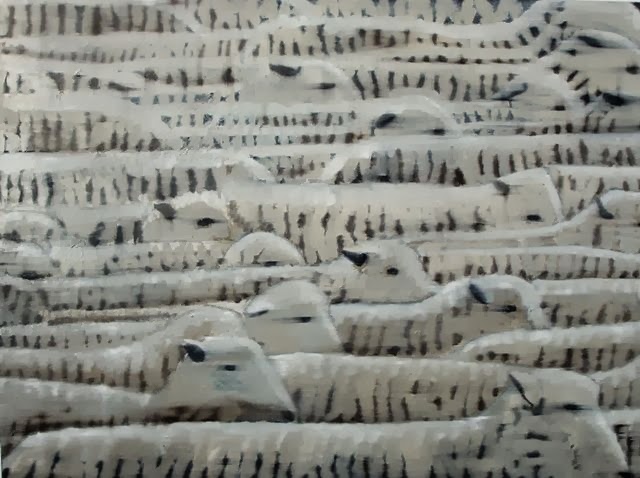 |
| Sheeps by Meagan Donegan |
.JPG)
.JPG)
.JPG)

Charles Saatchi owns your famous piece “My Bed,” an unmade bed with the detritus of a bad few months of depression in 1998. How does the bed get installed when it travels?[image: "My Bed," Tracey Emin, Saatchi Gallery]
I install it. Everything is in sealed containers, and it’s all labeled, like a crime scene. I did it in Frankfurt last year. I hadn’t seen it since 2008. I was thinking, with the cigarettes, that’s so weird because I don’t smoke anymore. I haven’t had sex for years, and there’s this condom. God, there’s a tampon, and I haven’t had a period for years. There’s my ex-boyfriend’s marijuana, I would never be with anyone who smokes marijuana now; there’s a whiskey bottle, and I don’t drink spirits. I get inside and pull the covers over me and then fold them back to look natural. I can actually smell the past. When I touched the condoms, I thought, Oh, I really loved that person who wore that condom. It’s a strange feeling, a good feeling. This ghost of me was still there.
But before we talk about movies we should talk about art in general, if that's possible. Given all the incredible suffering in the world I wonder, what is art for, really? If the collected works of Shakespeare can't prevent genocide then really, what is it for? Shouldn't we be spending the time and resources alleviating suffering and helping other people instead of going to the movies and plays and art installations? When we did Ocean's Thirteen the casino set used $60,000 of electricity every week. How do you justify that? Do you justify that by saying, the people who could've had that electricity are going to watch the movie for two hours and be entertained - except they probably can't, because they don't have any electricity, because we used it. Then I think, what about all the resources spent on all the pieces of entertainment? What about the carbon footprint of getting me here? Then I think, why are you even thinking that way and worrying about how many miles per gallon my car gets, when we have NASCAR, and monster truck pulls on TV? So what I finally decided was, art is simply inevitable. It was on the wall of a cave in France 30,000 years ago, and it's because we are a species that's driven by narrative. Art is storytelling, and we need to tell stories to pass along ideas and information, and to try and make sense out of all this chaos. And sometimes when you get a really good artist and a compelling story, you can almost achieve that thing that's impossible which is entering the consciousness of another human being - literally seeing the world the way they see it. Then, if you have a really good piece of art and a really good artist, you are altered in some way, and so the experience is transformative and in the minute you're experiencing that piece of art, you're not alone. You're connected to the arts. So I feel like that can't be too bad.[via Kottke]
 |
| CZECH REUPUBLIC: In the village of Nedašov, devils join the retinue of St. Nicholas to frighten children into being good. |
 |
| POLAND: Macidulas on New Year’s Day |
 |
| FRANCE: Bear at the Festival of the Bears |
 |
| ROMANIA: Stag on New Year’s Day |
 |
| ITALY: Schnappviecher (snapping beast) on Shrove Tuesday |
 |
| AUSTRIA: Every five years the men of Telfs collect lichen to create Wilder Mann, or Wild Man, costumes for the town’s Carnival festival. Tradition dictates that they nibble on a piece of this lichen before the festivities. |
 | |
| Portugal: During Carnival in Lazarim characters called “caretos” parade through the village in hand-carved masks to a bonfire where effigies known as the comadre and compadre are burned. |
If you thought Santa’s naughty list was intimidating, chances are you never encountered a Krampus.
A beastlike creature that is part of the pagan folklore of Alpine countries including Austria, Hungary, and Slovenia, the Krampus was to play “bad cop” so Santa could spend time focusing on the better behaved children.
The Krampus is also the first beast Charles Fréger encountered during his two-year journey through 19 European countries documenting pagan festivals. The resulting series, “Wilder Mann” is on view at Yossi Milo Gallery in New York through May 18 and is also available as a monograph titled Wilder Mann: The Image of the Savage published by Dewi Lewis Publishing.
A love story that spans decades is made poignant in this short video. In the late 1970s, Marina Abramović and Ulay fell in love and created art together. As they ended their relationship, they created art in that too. With Marina walking from the Yellow Sea and Ulay from the Gobi Desert, they each walked over 1000 miles to meet on the Great Wall of China. They hugged for a final time and left each other.
"At her 2010 MoMa retrospective Marina performed ‘The Artist Is Present’ as part of the show, where she shared a minute of silence with each stranger who sat in front of her. Ulay arrived without her knowing and this is what happened." (via zen garage)

 |
| The Couple |
 |
| Welcome |
 |
| All My Little Friends |
 |
| A Moment of Solitude |
 |
| Let's Stay Home |
 |
| Hello June |
 |
| The Neighborhood |


